
Victoria's Barwon South West region
Barwon South West runs from Geelong, Victoria's second-largest city, along the Great Ocean Road to the South Australian border. It's a region where the career and education depth of a major city sits alongside one of the world's most celebrated coastlines. If you're looking for real career options, affordable housing, and a short commute, this region is worth a close look.
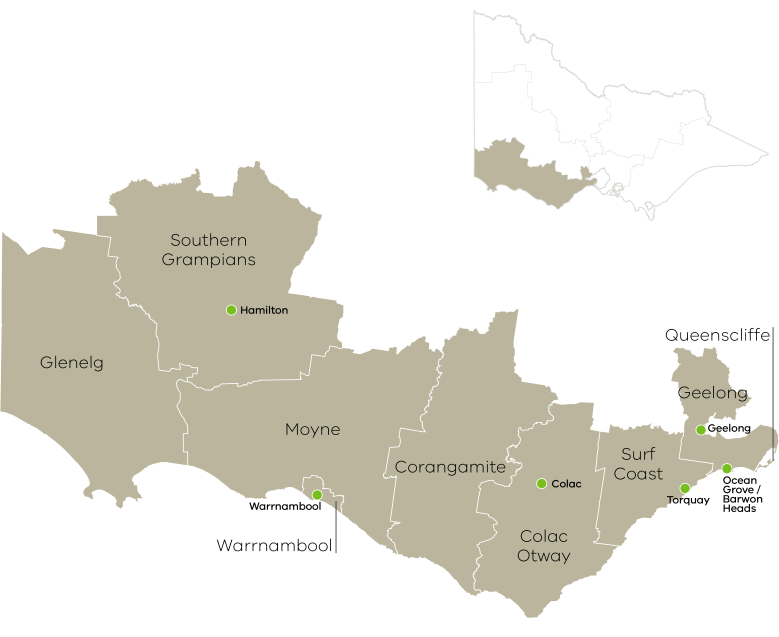
Barwon South West region at a glance
Key towns: Geelong, Warrnambool, Torquay, Colac, Ocean Grove, Hamilton, Portland, Lorne, Apollo Bay
Distance to Melbourne: Geelong 45-min express train
Population: 461,000+
Universities: Deakin University (three locations)
Hospitals: University Hospital Geelong, South West Healthcare Warrnambool
Average temperatures: 10-23°c (Summer), 5-13°c (Winter)
The commute averages 15 minutes. Melbourne is 45 minutes away by express train from Geelong. The Great Ocean Road starts where the city ends.
Employment and career opportunities
The region contributes more than $33 billion to Victoria's economy each year and employs over 237,000 people. The workforce has grown by more than 13% since 2019. There is strong demand across healthcare, manufacturing, defence, professional services, education and clean energy.
Healthcare
Healthcare is the largest employer in Barwon South West. University Hospital Geelong is one of the biggest regional hospitals in Victoria. It's supported by community health centres and specialist services across the region.
Engineering, manufacturing and defence
If your background is in engineering, manufacturing, or defence, companies like Alcoa, Hanwha Defence Australia, and Viva Energy offer strong career pathways.
Legal, medical, technology, administration and research
The Transport Accident Commission (TAC), National Disability Insurance Agency (NDIA), and WorkSafe Victoria all have major Geelong offices. They employ people in legal, medical, technology and administrative roles. Deakin University – with three Geelong campuses and one in Warrnambool – is both a major employer and research institution.
Clean energy
Clean energy is also growing fast. The proposed South West Renewable Energy Zone, Victoria's largest battery storage facility, and the Hycel hydrogen technology hub are creating new jobs for engineers, project managers and technical specialists.
Major employers
Major employers include: NDIA, WorkSafe Victoria, TAC, Deakin University, Alcoa, Viva Energy, Cotton On, Hanwha Defence Australia, Saputo, Bega, and Fonterra.
"There are renowned hospitals in all sorts of places in Victoria that I knew I could apply to work at, for me it was about my prospects of finding good jobs in the future." Alinie Guerreiro, from Brazil, settled in Warrnambool.
Housing
Housing in Barwon South West costs much less than in Melbourne – to rent and to buy. For many people considering where to settle, that makes a big difference.
Where you live in the region shapes your experience. Geelong's inner suburbs have heritage streetscapes and easy access to the city centre, and new housing estates offer more space at a lower cost. The Bellarine Peninsula and Surf Coast towns – Ocean Grove, Torquay, Anglesea – offer coastal living with a strong community feel. Towns further west, like Colac, Warrnambool, and Hamilton, are filled with character and are among the most affordable in the region.
Education
The region has strong education offerings at every level.
Schools
Government and independent schools operate across the region's towns and cities, from primary through to secondary level. Geelong has one of the strongest school systems of any regional city in Australia.
TAFE
Vocational training options in the region include:
- The Gordon - multiple campuses across Geelong
- South West TAFE - campuses in Warrnambool, Hamilton, Colac, and Portland
- RMIT - a campus in Hamilton
University
Deakin University has three campuses in Geelong and a fourth in Warrnambool, making it one of the most accessible regional universities in Victoria.
For families weighing up a move, the education pathways here are comprehensive – whether you're settling in Geelong, Warrnambool, or further west.
Health
The region's healthcare network is anchored by University Hospital Geelong, one of Australia's largest regional hospitals. It covers a full range of specialities: emergency, surgical, maternity, mental health, and more. A new dedicated Women's and Children's facility is currently under development at the same precinct, significantly expanding capacity for families.
Beyond the main hospital, the region has a layered network of services:
- Barwon Health North (Geelong north) - a walk-in Urgent Care Centre, open seven days a week for non-emergency conditions
- Urgent Care Clinic, Belmont - open seven days a week, no appointment or referral needed
- Community health centres - located in Corio, Belmont, Newcomb, Torquay, and Anglesea, providing GP and allied health services across the region
- South West Healthcare, Warrnambool - the main hospital and health service for the region's south-west
For the most complex or specialised treatment, Melbourne is around an hour away, close enough to be a genuine option when you need it. And the Virtual Emergency Department is available throughout Victoria too. This free service is available 24 hours and allows you to have a video consultation with Emergency doctors and nurses – providing peace of mind when you need it most.
Transport
There are many ways to travel within the region:
By car
Day to day, most people in Geelong and the larger towns describe commutes of around 15 to 20 minutes. Surf Coast towns are around an hour's drive from Melbourne. Warrnambool is approximately two and a half hours. The Great Ocean Road runs the length of the region's coastline.
By train
Geelong is 45 minutes from Melbourne by express V/Line train. The train also connects Warrnambool, Colac, and other regional towns directly to Melbourne's Southern Cross Station.
By air
Avalon Airport (located outside Geelong) offers domestic flights. Regional airports at Warrnambool, Portland, and Hamilton serve the south-west.
By ferry
The region is well connected by water:
- Queenscliff to Sorrento (Searoad Ferries) - a 40-minute car and passenger crossing which links the Bellarine Peninsula to the Mornington Peninsula
- Portarlington to Melbourne Docklands (Port Phillip Ferries)- a passenger ferry service used by both commuters and day-trippers
- Geelong to Melbourne Docklands (Port Phillip Ferries) - a direct ferry between Geelong and Melbourne's waterfront (weekends and holidays only)
- Geelong to Tasmania (Spirit of Tasmania) - the Tasmanian ferry service departs from North Geelong, connecting to Devonport, Tasmania
Community and culture
Geelong was named Australia's first UNESCO City of Design. It's a city that has been drawing people from around the world for decades, building a diverse and open community in the process. Deakin University attracts a large international community, and multicultural organisations, sporting clubs, arts groups, and local events are active across the region. They offer real entry points for new arrivals.
Geelong’s acclaimed Cultural Precinct brings together the Geelong Gallery, Geelong Arts Centre and the Geelong Courthouse.
The regional cultural calendar includes:
- Rip Curl Pro, Bells Beach
- Port Fairy Folk Festival
- Lorne Pier to Pub swim
- Toast to the Coast food and wine festival
The Great Ocean Road, the Otway Ranges, Bells Beach, and the Budj Bim UNESCO World Heritage site are all part of the landscape you'd be living in – not places you drive to on a long weekend but places you can enjoy every day.
"Why we chose Australia is because we love the outdoors, we love surfing, we love the nature…that made us choose this area and Victoria." Matthias Wockenfuss, from Germany, settled in Torquay (near Geelong)
Aboriginal First Nations Communities
Registered Aboriginal Parties (RAPs) are the primary guardians, keepers and knowledge holders of Aboriginal Cultural Heritage. They are the primary source of advice and knowledge on matters relating to Aboriginal places or Aboriginal objects in their region.
In the Barwon South West region, these are:
Settlement support
- Colac Otway Shire
- Corangamite Shire
- Glenelg Shire
- Greater Geelong
- Moyne Shire
- Queenscliffe Borough
- Southern Grampians Shire
- Surf Coast Shire
- Warrnambool City
- Colac Neighbourhood House, Colac
- Cultura, Geelong - multiple locations
- South West Healthcare, Warrnambool
A range of settlement services operate across the region to help you and your family get established. Local councils and community organisations provide practical help: from language support and employment pathways to social connection and help understanding local services.
Local councils in the region are:
Community organisations include:
Study Geelong also supports international students to connect with the community.
Further information on settlement services in the region can be found in the Great South Coast Settlement Guide.
| Major towns | Population | Key facts | Major industries and employers |
|---|---|---|---|
Geelong | 271,057 | Victoria's second-largest city. Express train to Melbourne in 45 minutes. Australia's first UNESCO City of Design. | Healthcare and social assistance, advanced manufacturing (food, textiles, aluminium, petroleum, engineering), education. Major employers: Transport Accident Commission (TAC), National Disability Insurance Agency (NDIA), WorkSafe Victoria, Deakin University, Alcoa, Viva Energy, Cotton On. |
Warrnambool | 35,406 | Region's main southern service centre for retail, health, education, and business. Significant dairy industry. Train to Melbourne in 3 hours. | Healthcare, education, retail, manufacturing, dairy and food processing, governance services. South West Healthcare. |
Torquay | 22,000+ | Home of Bells Beach and the Rip Curl Pro. Gateway to the Great Ocean Road. Fast-growing coastal community. | Tourism, retail, professional services. Major employers: Rip Curl, Quiksilver. |
Ocean Grove / Barwon Heads | 22,035 | Thriving coastal communities near the mouth of the Barwon River. Strong commuter links to Geelong. | Geelong provides the main employment base for residents. |
Colac | 13,000+ | Service centre for the Colac Otway Shire. Access to the Otway Ranges and Lake Colac. Train to Melbourne in 2 hours. | Agriculture, dairy, retail, health services. |
Hamilton | 10,000+ | Regional centre for the Southern Grampians. Gateway to the Grampians National Park. | Agriculture (wool, livestock), health, education, retail. |